Search Console's AI reports: what to check first
·
Quint-IA Vantage Team
Search Console's AI reports: what to check first
Search Console now has a generative AI performance report that counts how many times links to your site were shown in AI Overviews (the AI-written summary above search results) and AI Mode (Google's conversational search experience). Google says it reached all websites worldwide as of 31 August 2026.[1] That gives site owners a Google-supplied source for AI feature impressions, so third-party trackers are no longer the only option for that part. The report covers Google only. ChatGPT, Claude, Perplexity and the Gemini app need their own checks.
What does Search Console's AI report measure?
It measures one thing: impressions. Google defines an impression here as the number of times links to your site were shown to a user in a generative AI feature on Google Search.[1] The help page for the report describes no clicks, CTR or average position.
Data can be split by page, country, date and device, with dates in Pacific Time. Two search-type filters separate text queries ("Web: text-based") from image-based searches such as Google Lens and Circle to Search ("Web: multimodal"). The report covers AI Overviews and AI Mode. Google Discover has a separate report.[1]
The country dimension matters for companies that sell abroad. A business selling into the United States can filter to US searches and see how often its pages appeared in AI features for American users.
Because the metric counts links shown, it describes exposure. It does not say whether an answer quoted your page in its text.
Three limits are worth knowing. The report excludes data from Search Labs experiments, the 1,000-row cap of the Search performance report applies, and the newest data is preliminary and can change. Sites with too few impressions in AI features may not see the report at all.[1]
Why does one engine's data leave a gap?
Each engine draws on different sources, so Google's report cannot describe how ChatGPT or Perplexity treat your site. Peec AI analyzed about 30 million AI-cited sources in the US (March 2026). It found ChatGPT leaning on Wikipedia, Reddit and Forbes, while Google's AI Mode and AI Overviews favored YouTube, Reddit and Facebook.[2]
5W PR's State of AI Citations 2026 report estimates that only about 11% of domains are cited by both ChatGPT and Perplexity. The report does not name the study behind that figure, so treat it as a rough estimate.[3]
Do pages that rank in Google also get cited?
Often they do not. Ahrefs compared the URLs AI assistants cite with Google's top 10 results for the same queries. For ChatGPT, Gemini and Copilot, about 12% of cited URLs ranked in the top 10. Perplexity was higher, at 28.6%.[4]
Ranking position and AI exposure are separate measurements. Search Console now lets you compare them for Google's own AI features: the Performance report gives rankings and clicks, and the AI report gives impressions.
What should you check in the first week?
Four checks, in the order that is fastest to run.
Export AI impressions by page. Open the generative AI performance report, set the widest date range available, and export the Pages table.
Compare against ranked pages. Export your top pages by clicks from the standard Performance report. Pages that rank and earn clicks but never appear in the AI export make up your gap list.
Filter by country. If you sell into the US, filter to United States and repeat step 1.
Save a baseline. Record the totals and the date. Google marks the newest data as preliminary, so compare only after the dotted line has passed.
With an existing Search Console login, the whole pass takes about 30 minutes.
How do you cover the engines Search Console does not report on?
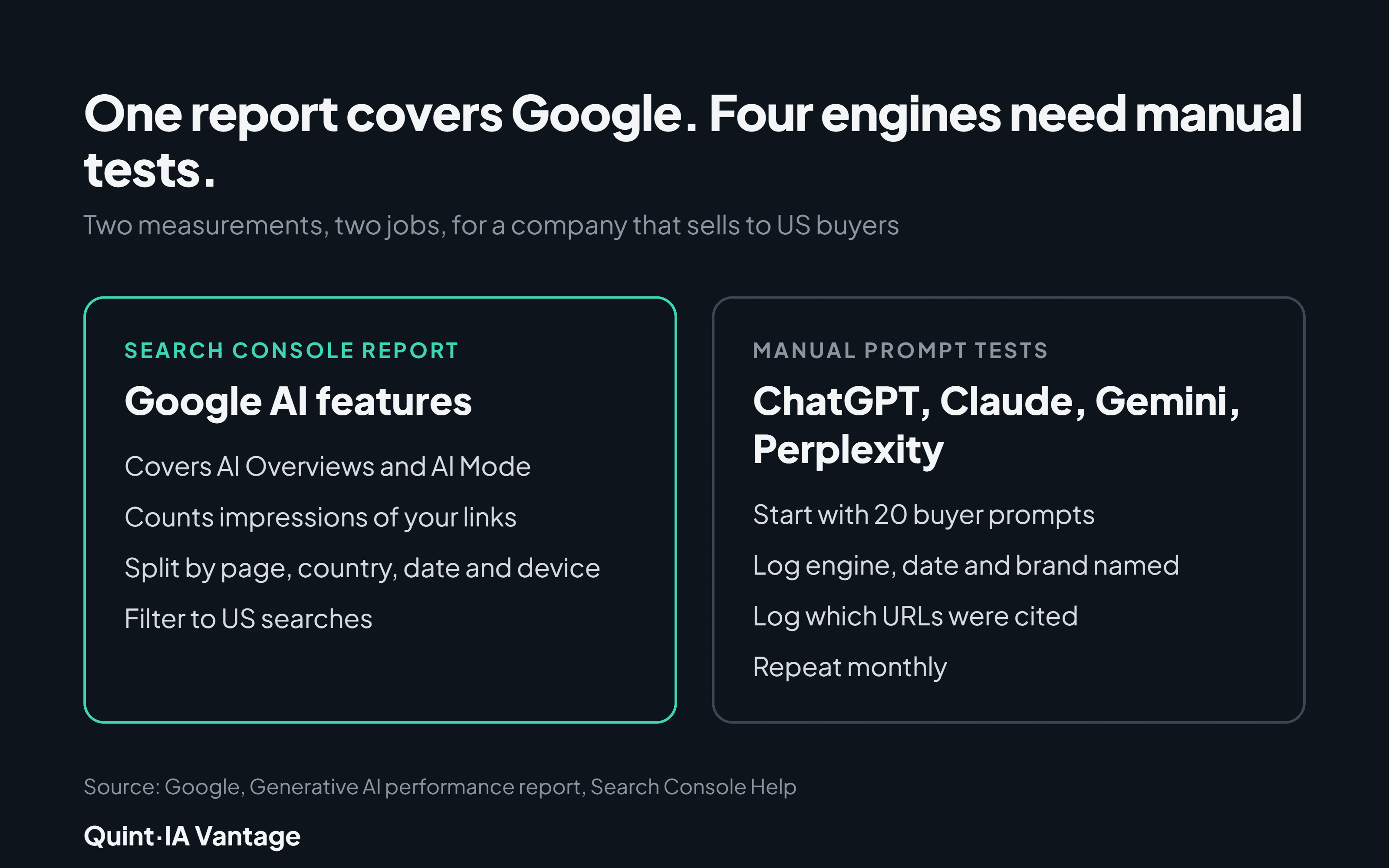
Run a fixed set of buyer prompts by hand in ChatGPT, Claude, Gemini and Perplexity and log the results. Start with 20 prompts that match how your buyers ask for vendors in your category. For each run, record the prompt, the engine, the date, whether your brand was named, and which URLs were cited.
Answers vary from run to run, so repeat the set monthly and track how often your brand appears rather than reading single results. Engines also change underneath you. Search Engine Roundtable reported that Gemini 3.8 Flash arrived in AI Mode without links and citations, and that Google fixed this later.[5] A monthly baseline shows shifts like that when they happen.
What to prioritize first
Start with the gap list from check 2. Those pages already hold rankings and an audience, which makes them the cheapest candidates for restructuring: put a direct answer in the first two sentences under each heading and add the specific numbers a reader would quote. Re-check their AI impressions after the next full reporting month.
Frequently asked questions
Can you opt out of Google's AI features in Search Console? Yes. Under Settings > Search generative AI, each property can be set to Include (the default), Exclude, or Inherit from its parent. Excluding hides your links and content from AI Overviews, AI Mode and Discover's AI features, so you receive no impressions or traffic from them. Google says the setting is not a ranking signal for other parts of Search.[6]
Does the report show clicks or CTR? Google's help page for the report defines impressions and lists no click, CTR or position data. Some third-party guides describe more metrics, so check the report in your own property before building a dashboard around it.[1]
Does the AI contribution pilot pay small sites? The coverage reviewed does not say. Search Engine Roundtable reports that Google is testing payments to publishers for content used in AI Mode, AI Overviews and Gemini, and that payouts seem small. A linked headline puts the pilot at roughly 100 publishers receiving about 0.1% of ad revenue. Eligibility for small sites: [NEEDS SOURCE].[5]
Does the report cover ChatGPT or Perplexity? No. It covers AI Overviews and AI Mode on Google Search, with Discover in a separate report. ChatGPT, Claude, Gemini and Perplexity need prompt-level checks, run by hand or with a tracking tool.[1]
Run a Quick-Start Blueprint on your domain to see how ChatGPT, Claude and Perplexity cite you, next to what Search Console shows for Google.
References
Google, Generative AI performance report (Search), Search Console Help: https://support.google.com/webmasters/answer/16984139
Peec AI, analysis of about 30 million AI-cited sources, 31 March 2026: https://peec.ai/ai-search-geo-statistics
5W PR, The State of AI Citations 2026: https://www.5wpr.com/research/state-of-ai-citations-2026/
Ahrefs, AI search overlap with Google results, 2025: https://ahrefs.com/blog/ai-search-overlap/
Search Engine Roundtable, October 2026 Google Webmaster Report (1 October 2026): https://www.seroundtable.com/october-2026-google-webmaster-report-42185.html
Google, Search generative AI control, Search Console Help: https://support.google.com/webmasters/answer/16908024